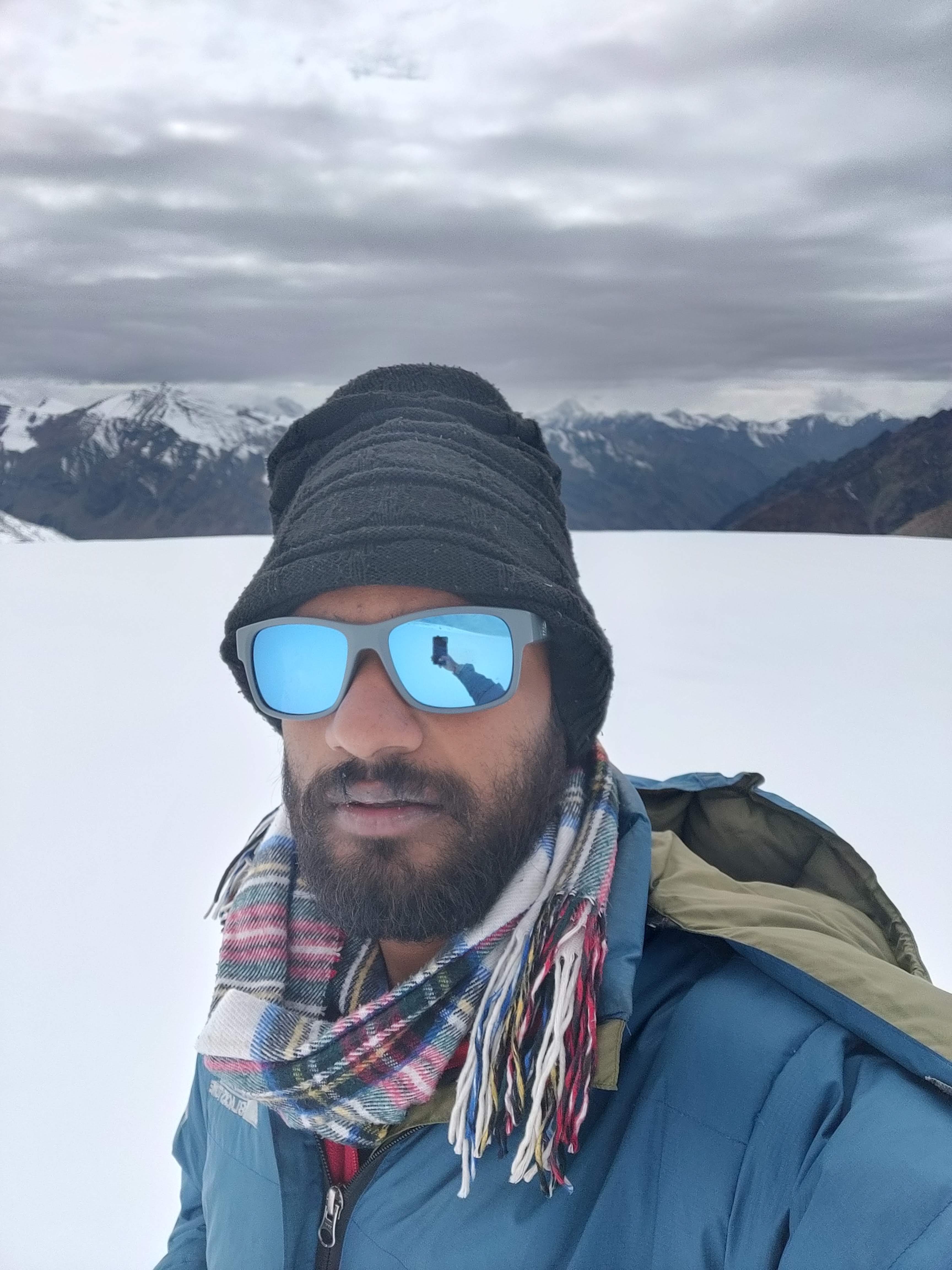
Nobody tells you what leading your first 6,000m expedition actually feels like. They talk about the summit. Nobody talks about the weight you carry — and how heavy it gets above 5,000m.
Why Yunam Peak
Yunam Peak sits above the Baralacha La pass on the Manali–Leh highway corridor, in the Lahaul district of Himachal Pradesh. It's technically non-demanding — no glacier travel, no fixed ropes on the standard route, no crevasse risk. What it has is altitude, a lot of loose scree on the upper sections, and a base camp that sits at nearly 5,000m, which means your body is already working hard before you take a single step upward.
For a first 6,000m expedition as leader, Yunam was the right choice. The mountain itself isn't going to kill you with technical complications. That frees you to focus on what actually matters on any expedition: the people.
What Nobody Tells You About Leading Above 5,000m
When you're a team member on a high-altitude expedition, your job is relatively simple: take care of yourself, follow the leader's calls, summit if conditions allow. When you're the leader, your job is completely different. You're managing every other person's altitude experience simultaneously. You're making decisions for people who may not be able to make good decisions for themselves.
Acute Mountain Sickness affects judgement. That's not a metaphor — it literally impairs cognitive function. Which means that above 5,000m, you may be surrounded by people whose ability to assess their own condition has been compromised by the very conditions you're in. They'll tell you they're fine when they're not. They'll underestimate their symptoms. They'll want to push on because they've come a long way and the summit is right there.
"Above 5,000m, the mountain strips away everyone's pretences. What you see in your team up there is who they actually are. And your job as leader is to see it clearly, even when you're also tired and cold and thin-aired."
The Acclimatisation Problem at Yunam
Yunam's base camp is accessible by road — the Manali–Leh highway passes close enough that you can drive to within striking distance. This is both convenient and dangerous. It means there's no mandatory walk-in acclimatisation period. Teams can, and sometimes do, drive from 2,000m in Manali to 4,800m at base camp in a single day. That's a disaster waiting to happen.
We built in two acclimatisation days in Keylong (3,100m) and a night at 4,200m before reaching base camp. Even then, two of our six members woke at base camp with classic AMS symptoms — headache, nausea, fatigue. We rested. I've never regretted a rest day on any expedition. I've occasionally regretted not taking one.
Day 1 of Climbing: Reading the Mountain and the Team
The approach to Yunam's summit starts across a broad high plateau and then up loose scree and rock. The initial slopes are gentle enough that you can move at a comfortable pace. This is where I do most of my observation work — watching who's pacing well, who's burning matches too early, who's moving quietly and efficiently versus who's making effort visible.
One member — let's call him P — was a strong runner at sea level. Fit, experienced at altitude up to 4,500m, confident. He was also, I noticed, pushing harder than anyone in the first two hours. Moving five metres ahead, stopping, waiting, then pushing again. Classic ego-altitude pattern. I dropped back to walk with him for twenty minutes and just talked — nothing about pace, nothing about the mountain. By the time we finished talking, he'd naturally slowed to match the group. Sometimes the solution to ego at altitude is just company and conversation.
The Summit
We reached the summit plateau at around 6,050m in early afternoon — later than ideal, but the team was intact and moving well. The final push to the true summit at 6,150m took another forty minutes of careful footwork on loose rock.
All six of us summited. I'm still proud of that. Not because of the number — because of what it took to hold the group together through the altitude and the discomfort and the moments when individuals wanted to move faster than was safe. A 100% summit rate on a first 6,000m expedition, with a mixed-experience team, on a mountain that punishes poor acclimatisation: that's the result I'm proudest of.
What Yunam Peak Taught Me
Leading this expedition changed how I think about high-altitude work. The technical skills matter — rope management, crampon technique, navigation. But the real differentiator in expedition leadership is reading people. Understanding who needs to be slowed down and who needs to be encouraged forward. Knowing when a complaint signals genuine distress versus discomfort. Learning to make the call to turn someone around without making them feel like a failure.
Yunam Peak also taught me that the mountain doesn't care about your plans. We had a weather window close on Day 2 of the approach — not badly, but enough to require a two-hour wait in wind that cut through every layer. Two members were shivering significantly. The group's morale dipped. The skill in that moment is not summit optimism — it's holding the group in the present, practical and steady, until the window reopens.
I went on to lead Kang Yatse 2 at 6,250m the following year. Yunam Peak was the education that made that possible. Every expedition teaches you something the classroom cannot. Get on the mountain. Lead something. Fail at some things. Succeed at others. That's the only curriculum that matters.